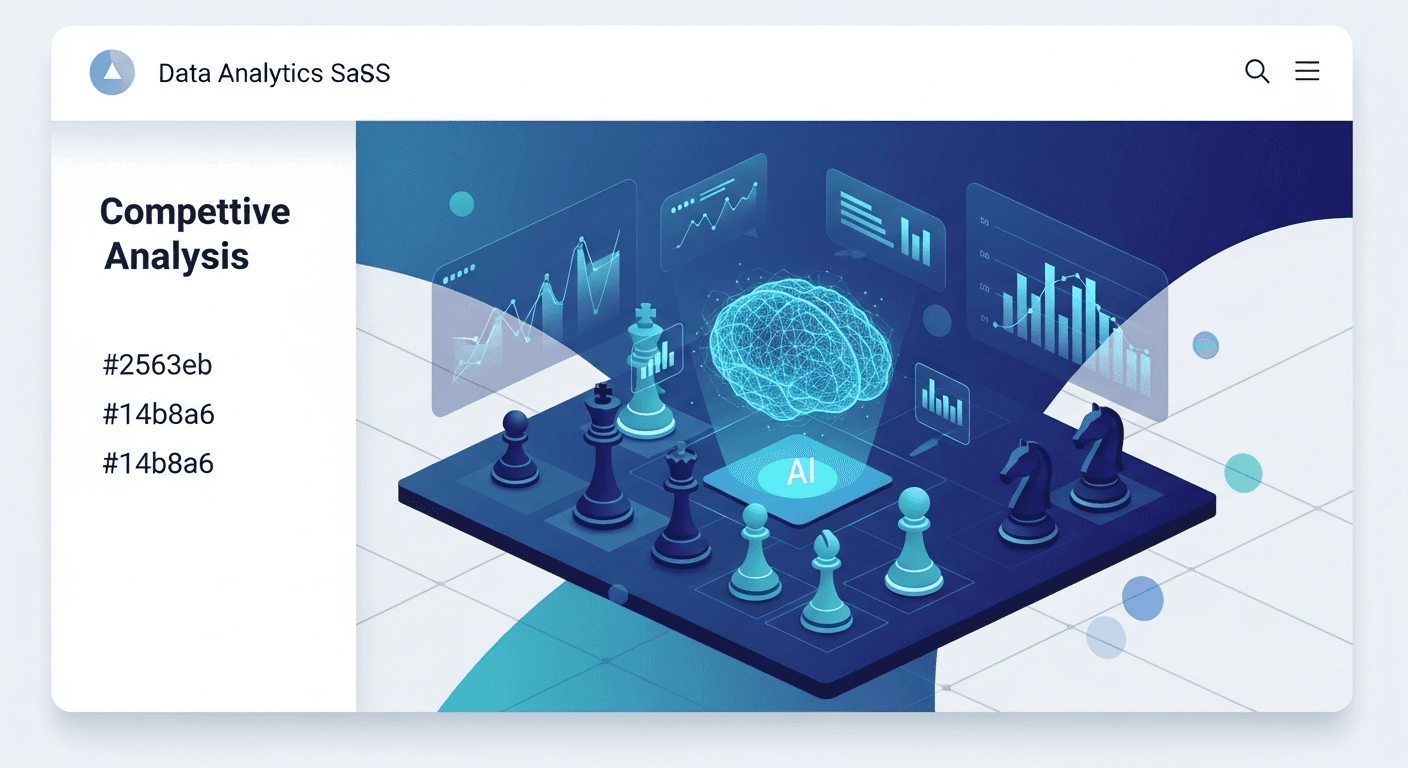
Competitive Analysis Using Generative AI Search Data
Learn how to conduct competitive analysis using generative AI search data. Discover tools, methodologies, and strategies for gaining competitive intelligence with AI.
Ashesh Dhakal
Published February 19, 2026
Introduction: A New Frontier in Competitive Intelligence
Competitive analysis has always been about understanding what your rivals are doing, where they are headed, and how to position yourself to win. But in 2026, the rise of generative AI search engines -- from Google's AI Overviews to ChatGPT search, Perplexity, and others -- has created an entirely new dimension of competitive intelligence. Understanding how to conduct competitive analysis using generative AI search data is quickly becoming a must-have skill for business strategists, marketers, and product teams.
For teams that want to turn raw competitive data into actionable insights without manual coding, a data analysis AI platform like AnalyzeData can accelerate the process dramatically. Our data analysis hub covers related techniques and tool guides that complement the competitive intelligence workflow described here. Upload your competitive datasets -- scraped AI search results, citation data, brand mention frequencies -- and get instant analysis with visualizations and statistical summaries that reveal patterns human review would miss.
This guide walks you through the methodology, tools, data sources, and best practices for conducting competitive analysis using generative AI search data. Whether you are tracking how competitors appear in AI-generated answers, monitoring brand visibility across AI search platforms, or analyzing the content strategies that earn AI citations, this article provides a comprehensive framework.
Why Generative AI Search Data Matters for Competitive Analysis
The Shift from Traditional Search to AI Search
Traditional search engine results pages (SERPs) have been the backbone of competitive analysis for two decades. Tools like SEMrush, Ahrefs, and Moz built entire industries around tracking keyword rankings, backlink profiles, and organic traffic estimates. These tools remain valuable, but they are increasingly incomplete.
Generative AI search engines work differently. Instead of returning a list of ten blue links, they synthesize information from multiple sources and present a direct answer. This means:
- Visibility is no longer just about ranking position. A brand can be mentioned in an AI-generated answer without appearing in traditional search results at all.
- Citation patterns reveal authority signals. Which sources do AI models cite? How often? This creates a new competitive metric.
- User behavior is shifting. A growing percentage of informational queries are being answered within AI search interfaces, meaning fewer users click through to traditional results.
- Content strategy must evolve. The content that gets cited by AI models is not always the same content that ranks highest in traditional search.
The Competitive Intelligence Gap
Most businesses are still running competitive analysis using pre-AI methodologies. They track keyword rankings, monitor competitors' ad spend, and analyze backlink profiles. While this remains useful, it misses the generative AI layer entirely. Companies that understand how to extract, analyze, and act on AI search data gain a significant strategic advantage.
Consider this: if a competitor is consistently cited by ChatGPT, Perplexity, and Google AI Overviews as the authoritative source for a key industry topic, they are capturing mindshare in a channel that traditional competitive tools do not measure. That is the gap generative AI search data fills.
How Generative AI Search Engines Generate Answers
Before diving into methodology, it helps to understand how these systems work, because that understanding shapes what data you can extract and how to interpret it.
Retrieval-Augmented Generation (RAG)
Most generative AI search engines use a retrieval-augmented generation approach:
- Query understanding -- The AI interprets the user's question, identifies intent, and determines what information is needed.
- Source retrieval -- The system queries an index of web content (or a real-time search engine) to find relevant documents.
- Answer synthesis -- A large language model reads the retrieved documents and generates a coherent answer.
- Citation attribution -- The system attributes claims to specific sources, providing links for users to verify.
What This Means for Competitive Analysis
Each step in this process creates data you can analyze:
- Query understanding reveals what topics and questions your target audience cares about.
- Source retrieval reveals which competitors' content is being pulled into the AI's knowledge base.
- Answer synthesis reveals how brands and products are positioned in AI-generated narratives.
- Citation attribution reveals which sources the AI considers authoritative.
Step-by-Step Methodology for AI Search Competitive Analysis
Step 1: Define Your Competitive Landscape
Start by identifying the competitors, topics, and queries that matter for your business:
- Direct competitors -- Companies selling similar products or services to your target audience.
- Content competitors -- Websites that compete for visibility on the same topics, even if they sell different products.
- Key topics -- The subject areas most important to your business and customers.
- Target queries -- Specific questions your audience asks that relate to your product category.
Build a query list of 50-200 questions that represent your competitive landscape. Categorize them by topic, intent (informational, commercial, navigational), and priority.
Step 2: Collect AI Search Data Across Platforms
Run your target queries across multiple generative AI search platforms and capture the results:
Platforms to monitor:
| Platform | Data Available | Collection Method |
|---|---|---|
| Google AI Overviews | AI-generated summaries, cited sources, follow-up questions | Manual collection, third-party SERP APIs |
| ChatGPT (search mode) | Full answers, citations, source links | Manual collection, API access |
| Perplexity | Answers with inline citations, source list | API access, manual collection |
| Microsoft Copilot (Bing) | AI answers, cited sources | Manual collection, Bing API |
| Claude (web search) | Answers with citations | Manual collection |
| Gemini | AI summaries, linked sources | Manual collection |
Data points to capture for each query:
- The full AI-generated answer text
- All cited sources (URLs, domains, page titles)
- Position of citations within the answer (first mention carries weight)
- Whether your brand or competitors are mentioned by name
- Follow-up questions suggested by the AI
- Date and time of the query (answers can change over time)
Step 3: Structure and Clean Your Data
Once collected, structure your data into analyzable formats. A typical dataset might include:
Query | Platform | Answer Text | Cited Sources | Brand Mentions | Date
This is where tools like Analyze Data AI become invaluable. Upload your structured competitive data and let the AI identify patterns across hundreds of queries -- which competitors appear most frequently, which content types earn citations, and how visibility varies across platforms.
For more on how AI tools can accelerate this kind of analysis, see our guide on the best AI tools for data analysis. If you want to dive deeper into general methodology, our article on data analysis using AI covers best practices that apply to competitive datasets as well.
Step 4: Analyze Citation Patterns
Citation analysis is the core of generative AI competitive intelligence. Look for:
Citation frequency: How often is each competitor cited across your query set? Calculate a "share of AI voice" metric:
AI Share of Voice = (Number of citations for Brand X / Total citations across all queries) x 100
Citation position: Being the first cited source in an AI answer carries more weight than being the fifth. Track average citation position for each competitor.
Platform variation: A competitor might dominate in Perplexity answers but be absent from Google AI Overviews. This reveals platform-specific content strategies.
Topic clustering: Which competitors dominate which topic areas? You might find that Competitor A owns "pricing" queries while Competitor B dominates "how-to" queries.
Step 5: Analyze Content That Earns Citations
Examine the actual content pages that get cited to understand what generative AI systems prefer:
- Content format -- Long-form guides, data studies, FAQ pages, product comparisons?
- Content structure -- Clear headings, tables, bulleted lists, structured data markup?
- Content freshness -- How recent is the cited content? Does recency correlate with citation frequency?
- Domain authority -- Do traditional authority signals (backlinks, domain age) correlate with AI citations?
- Content depth -- Word count, number of subtopics covered, presence of original data or research?
Build a scoring model that predicts what content characteristics earn AI citations in your industry.
Step 6: Monitor Changes Over Time
AI search results are not static. Models get updated, source indexes get refreshed, and competitors publish new content. Set up regular monitoring:
- Weekly query runs for your top-priority queries
- Monthly full sweeps across your entire query set
- Quarterly trend analysis to identify shifting competitive dynamics
- Alert triggers when a competitor's AI visibility changes significantly
Step 7: Develop Strategic Recommendations
Translate your analysis into actionable strategy:
- Content gaps -- Topics where competitors are cited but you are not. Create authoritative content to fill these gaps.
- Content optimization -- Pages you already have that could earn more citations with structural improvements.
- Platform strategy -- Prioritize the AI search platforms where your audience is most active.
- Brand positioning -- How AI systems describe your brand versus competitors. Identify narrative opportunities.
Tools and Platforms for AI Search Competitive Analysis
Dedicated AI Search Monitoring Tools
Several tools have emerged specifically for tracking brand visibility in AI-generated answers:
Ottimo: Tracks brand mentions and citations across major AI search platforms. Provides dashboards for AI share of voice and citation trends.
Profound: Monitors how AI chatbots and search engines reference brands and products. Useful for tracking brand sentiment in AI-generated content.
Scrunch AI: Focused specifically on AI search optimization, providing data on how content performs in generative AI results.
Traditional SEO Tools with AI Features
Established SEO platforms are adding AI search tracking:
SEMrush: Added AI Overview tracking to their SERP analysis toolkit, letting you see which URLs appear in Google's AI-generated answers.
Ahrefs: Provides data on AI Overview appearances alongside traditional ranking data.
BrightEdge: Enterprise-focused platform with AI search visibility metrics.
Data Analysis Platforms
For the analysis phase, you need tools that can handle large datasets of query results, citation data, and competitive metrics:
AnalyzeData: Upload your collected AI search data and get instant statistical analysis, trend identification, and AI-powered visualizations. Particularly useful for identifying citation patterns across hundreds of queries without writing code.
Python with pandas: For technical teams, custom analysis scripts offer maximum flexibility. If you are interested in automating this with AI assistance, our guide on AI-assisted code generation for data analysis covers tools that generate Python analysis code from natural language descriptions.
Web Scraping and Data Collection
BrightData: Provides web scraping infrastructure for collecting SERP data at scale, including AI-generated results.
SerpAPI: API access to search engine results, including AI Overview data from Google.
Custom scripts: For platforms with API access (like Perplexity), custom collection scripts give you the most control over what data you capture.
Case Examples: AI Search Competitive Analysis in Practice
Example 1: SaaS Product Category Analysis
A project management software company wants to understand how AI search engines describe their product category.
Query set: 75 queries related to "project management software," "task management tools," "team collaboration platforms," and related topics.
Findings:
- Competitor A was cited in 62% of AI-generated answers across all platforms
- The company was cited in only 18% of answers
- Competitor A's advantage came from a single comprehensive comparison page that AI systems preferred
- The company's product pages lacked the structured comparison data AI models pull from
Action: Created a detailed, regularly updated comparison page with structured data markup. Within three months, AI citation rate increased to 41%.
Example 2: E-commerce Brand Monitoring
An electronics retailer tracked how AI search engines responded to product recommendation queries.
Query set: 120 queries in the pattern of "best [product category] 2026," "which [product] should I buy," and "[product A] vs [product B]."
Findings:
- AI answers heavily favored editorial review sites over retailer product pages
- When retailers were cited, those with rich product data (specs, comparisons, user reviews) appeared more frequently
- Competitor retailers with structured product data appeared 3x more often in AI answers
Action: Enhanced product pages with comprehensive specification tables, comparison widgets, and aggregated review summaries. Focused content strategy on editorial-style buying guides published on their blog.
Example 3: Financial Services Authority Tracking
A fintech company monitored how AI search positioned them relative to traditional banks for financial advice queries.
Query set: 200 queries about personal finance, investing, banking products, and financial planning.
Findings:
- Traditional banks dominated citations for "safe" queries (savings accounts, CDs)
- Fintech companies were preferentially cited for "modern" queries (crypto, robo-advisors, digital payments)
- The company was absent from 73% of queries where at least one fintech competitor was cited
- Content depth and regulatory compliance signals (disclaimers, credentials) correlated with citation frequency
Action: Invested in comprehensive educational content for financial topics where they were underrepresented, ensuring proper regulatory language and expert attribution.
Best Practices for Competitive Analysis Using Generative AI Data
1. Standardize Your Data Collection
Consistency is critical for meaningful analysis. Use the same query phrasing, collection timing, and platform versions across all data collection sessions. Small variations in query wording can produce different AI answers.
2. Account for AI Answer Variability
Generative AI answers are not deterministic. The same query can produce different answers on different days or even different sessions. Run multiple collections for high-priority queries and look for patterns rather than individual results.
3. Combine AI Search Data with Traditional Metrics
AI search data is most powerful when combined with traditional competitive intelligence:
- Overlay AI citation data with organic traffic estimates
- Compare AI share of voice with traditional search share of voice
- Correlate AI visibility changes with known competitor content updates
- Track how AI search visibility relates to actual business outcomes (leads, sales)
4. Focus on Actionable Insights
It is easy to get lost in data collection and miss the strategic point. Every analysis should answer specific business questions:
- Where are we losing visibility to competitors in AI search?
- What content do we need to create or improve?
- Which AI platforms matter most for our audience?
- How is our competitive position changing over time?
5. Respect Legal and Ethical Boundaries
When collecting AI search data:
- Comply with each platform's terms of service regarding automated querying
- Do not misrepresent collected data or manipulate AI systems
- Be transparent with stakeholders about the methodology and its limitations
- Respect rate limits and fair use policies
Limitations and Challenges
Data Collection at Scale
Unlike traditional SERP data, which is available through numerous APIs and tools, generative AI search data is harder to collect systematically. Many AI search platforms do not offer APIs for this purpose, requiring manual collection or custom scraping solutions that may violate terms of service.
Answer Variability and Reproducibility
AI-generated answers can vary between sessions, making reproducibility a challenge. A competitor might be cited in one instance but not another for the same query. Statistical approaches that aggregate across many observations are more reliable than individual query analysis.
Attribution Accuracy
AI systems sometimes synthesize information without clear attribution, or attribute information to the wrong source. Citation data should be treated as directional rather than perfectly precise.
Rapid Platform Evolution
Generative AI search platforms are evolving quickly. New features, model updates, and interface changes can shift citation patterns overnight. What works today may need to be recalibrated in a few months.
The Measurement Gap
There is currently no industry-standard metric for "AI search visibility" equivalent to traditional search rankings. Methodologies are still emerging, and comparing data across different platforms requires careful normalization.
Emerging Trends in AI Search Competitive Intelligence
AI Search Optimization (AISO) as a Discipline
Just as SEO emerged as a discipline for traditional search, AI Search Optimization is becoming a recognized practice. Expect dedicated roles, agencies, and toolsets focused specifically on optimizing brand visibility in AI-generated answers.
Real-Time Competitive Monitoring
As monitoring tools mature, expect real-time dashboards that track your AI search visibility alongside competitors, with automated alerts when significant changes occur.
Multi-Modal AI Search
AI search is expanding beyond text. Visual search (Google Lens, GPT-4V), voice search, and video search all create new competitive dimensions. Forward-thinking analysis should consider how competitors appear across all modalities. For a deeper look at the visual data side, explore our guide on AI tools for data visualization or our roundup of the best AI data visualization tools.
Integration with Business Intelligence
AI search competitive data will increasingly feed into broader business intelligence platforms, combining with sales data, customer feedback, and market research for holistic competitive views.
How AnalyzeData Helps
Competitive analysis using generative AI search data produces large, complex datasets -- hundreds of queries across multiple platforms, with citation data, brand mentions, sentiment scores, and temporal trends. Making sense of this data manually is time-consuming and error-prone.
AnalyzeData is purpose-built for exactly this kind of analytical challenge:
- Upload your competitive datasets -- CSV exports of query results, citation tracking spreadsheets, brand mention logs -- and get instant AI-powered analysis
- Automatic pattern detection identifies which competitors dominate which topics and platforms without manual pivot table creation
- AI-generated visualizations show competitive trends, share of voice distributions, and citation patterns at a glance
- Statistical summaries highlight statistically significant differences in competitive positioning
- Natural language querying lets you ask follow-up questions about your competitive data: "Which competitor gained the most AI visibility in the last month?" or "What content types correlate with higher citation rates?"
- No coding required -- business strategists, marketing managers, and product teams can run competitive analysis independently
Whether you are conducting your first AI search competitive analysis or building an ongoing monitoring program, AnalyzeData turns raw competitive data into strategic intelligence in minutes rather than days.
Try AnalyzeData free -- upload your competitive data and get instant insights
Frequently Asked Questions
What is generative AI search data, and why does it matter for competitive analysis?
Generative AI search data refers to the information produced by AI-powered search engines -- platforms like Google AI Overviews, ChatGPT search, Perplexity, and Microsoft Copilot -- when they generate answers to user queries. This data matters for competitive analysis because a growing share of user queries are being answered directly by AI, creating a new competitive arena that traditional SEO tools do not fully capture. Brands that appear in AI-generated answers gain visibility, authority, and influence that competitors who are absent do not.
How do I track which competitors appear in AI-generated search results?
Start by building a list of target queries relevant to your industry. Run these queries across major AI search platforms (Google AI Overviews, ChatGPT, Perplexity, Copilot) and record the cited sources, brand mentions, and answer content for each. For a dedicated look at the monitoring platforms available, see our guide on the best tools for AI search data analysis. Tools like Ottimo, SEMrush (AI Overview tracking), and SerpAPI can help automate parts of this process. Upload the collected data to an analysis platform like AnalyzeData to identify patterns and trends across your entire query set.
Can generative AI search data replace traditional competitive analysis tools?
No, generative AI search data should complement traditional competitive analysis, not replace it. Traditional tools (SEMrush, Ahrefs, SimilarWeb) still provide valuable data on organic rankings, paid advertising, backlinks, and traffic estimates. The most effective approach combines both data sources to create a complete picture of competitive positioning across all search channels.
How often should I run AI search competitive analysis?
For ongoing monitoring, run your highest-priority queries weekly and conduct a full sweep of your complete query set monthly. Quarterly trend analysis helps identify longer-term shifts in competitive positioning. If a major competitor launches new content or a significant AI platform update occurs, run an ad-hoc analysis to assess the impact.
What are the biggest challenges in conducting competitive analysis with AI search data?
The primary challenges are data collection at scale (many AI platforms lack APIs for systematic querying), answer variability (the same query can produce different results across sessions), rapidly evolving platforms (model updates can shift citation patterns), and the lack of industry-standard metrics. Address these by focusing on statistical patterns across many observations rather than individual query results, maintaining consistent collection methodology, and regularly updating your approach as tools and platforms evolve.
Key Takeaways
- Generative AI search engines create a new competitive dimension that traditional SEO and competitive analysis tools do not fully capture, making AI search data essential for comprehensive competitive intelligence
- AI share of voice -- measured by citation frequency, brand mentions, and citation position across AI search platforms -- is an emerging metric that reveals competitive positioning in AI-generated answers
- A structured methodology involving query definition, multi-platform data collection, citation analysis, content examination, and ongoing monitoring provides actionable competitive insights
- Citation analysis reveals which competitors are treated as authoritative sources by AI systems, and what content characteristics earn citations in your industry
- Combine AI search data with traditional competitive metrics for a complete picture of competitive positioning across all channels
- Tools are rapidly maturing -- dedicated AI search monitoring platforms, alongside traditional SEO tools adding AI features, are making systematic analysis more accessible
- Content strategy should evolve to address AI search visibility, focusing on structured data, comprehensive coverage, and authoritative sourcing that AI models prefer
- Regular monitoring is essential because AI search results are dynamic, and competitive positioning can shift with model updates, new content, or platform changes
- Platforms like AnalyzeData can accelerate the analysis phase by automatically identifying patterns in large competitive datasets without requiring manual coding or pivot table creation
Ashesh Dhakal
Founder & Data Scientist
Ashesh Dhakal is a Data Science student at the University of Manitoba and a full-stack developer specializing in AI-powered applications. He holds a Computer Programming Diploma with Honors. His expertise spans explainable AI, natural language processing, and building production AI platforms.
Related Articles
![Agentic AI for Data Analysis: What It Is & When to Use It [2026]](/_next/image?url=%2Fimages%2Fblog%2Fagentic-ai-for-data-analysis.png&w=3840&q=75)
Agentic AI for Data Analysis: What It Is & When to Use It [2026]
What is agentic AI for data analysis? Learn how autonomous AI agents analyze data end-to-end, the best agentic AI tools, and when agentic AI beats traditional AI assistants.
How to Use AI to Analyze Excel Data (Free & Instant)
The fastest way to analyze Excel data with AI — no coding, no complex formulas. Upload your .xlsx file and get instant insights, trends, and charts using AI.
Best AI for Analyzing Data in 2026: Honest Comparison
The best AI for analyzing data in 2026, tested and compared. Find the right AI data analyzer for your needs — from free tools to enterprise platforms.