Will AI Replace Data Analysts? An Honest Answer
Will AI replace data analysts? The honest answer from a team building an AI data analyst: which tasks are already automated, which aren't close, what the jobs numbers say, and what to learn.
Ashesh Dhakal
Published July 18, 2026 · Updated July 18, 2026
We should be the most biased possible source on this question: AnalyzeData is literally an AI data analyst — that's the tagline. If AI were about to replace analysts wholesale, it would be in our interest to say so loudly. Here's why we don't believe it, task by task, and what the numbers and the honest tradeoffs actually show.
What AI already does better
Be honest about this half first. For well-formed questions on well-formed data, AI tools with code execution are faster and less error-prone than most humans:
- The mechanical query: "revenue by channel, this quarter vs last" — written as pandas, executed, charted in seconds. No analyst should spend an afternoon on this in 2026.
- The first-pass sweep: distributions, outliers, correlations across every column — breadth a human wouldn't bother with on a Tuesday.
- The drafting: turning computed results into a readable summary and a clean chart. This was never the intellectually hard part, but it consumed the hours.
This is real displacement — of tasks. An analyst whose entire value was translating stakeholder requests into GROUP BY statements is now competing with a tool that does it in seconds for free, and that's worth saying plainly rather than dressing up. The useful way to read it: AI didn't take a job, it took the bottom 30–40% of a job's task list — the part that was tedious anyway. What's left is denser and harder, not empty.
What AI is nowhere near
- Choosing the question. The stakeholder asks "why is revenue down?" The analyst knows the honest decomposition is price vs volume vs mix, that the CFO's real worry is one enterprise account, and that last year's number was inflated by a one-off. AI answers the question asked; analysts fix the question first. That skill is context, and the context lives in rooms and Slack threads the model isn't in.
- Distrusting the data. The pipeline that double-counts on Mondays. The "active users" definition that changed in March. Real-world data is a minefield of silent lies, and knowing where the bodies are buried is unautomatable institutional knowledge — a model will confidently average a broken column, because the numbers look fine.
- Accountability. When the board-deck number is wrong, someone owns that. "The AI said so" is not a defense any organization accepts — which is why serious AI analysis must show its work. (It's why every number in our product carries the code that computed it: the human stays in the verification loop by design.)
- The politics of the answer. Knowing that a finding kills a VP's pet project, and how to present it so the data wins anyway — that's the job's hard mode, and it's entirely human.
What the jobs numbers actually say
If AI were hollowing out the profession, you'd expect the employment outlook to be turning down. It isn't. The U.S. Bureau of Labor Statistics projects employment of data scientists — the occupation category that absorbs much of what we loosely call "data analysis" — to grow 34% from 2024 to 2034, which it labels "much faster than the average for all occupations," with about 23,400 openings projected each year over the decade and a 2024 median pay of $112,590.
Two honest caveats. First, BLS doesn't track a clean "data analyst" occupation; the work is split across data scientists, operations research analysts, and management analysts, so no single number is the last word. Second, a projection made in one year can't fully price in a fast-moving technology — treat it as a strong directional signal, not a guarantee. But the direction is clear, and it's the opposite of collapse. The reputable career guidance lands in the same place: Coursera's own review of the question concludes that "most data analyst roles are unlikely to be replaced by generative AI," while noting that most analysts will use AI daily.
What actually happens to the role
The same thing that happened to accountants with spreadsheets and developers with compilers: the floor rises. The analyst role bifurcates —
- Report-production roles shrink. Where the job was assembling the same monthly numbers, automation is now table stakes. This transition is genuinely painful for people in those seats, and pretending otherwise is marketing, not analysis.
- Judgment roles expand. Someone must direct the AI at the right questions, audit what comes back, and translate findings into decisions — across far more questions than any team could previously afford to ask. Cheaper analysis increases the demand for analysis; the bottleneck moves to judgment. When the marginal cost of a query falls, organizations ask ten times as many, and each one still needs a human to decide whether the answer is trustworthy and what to do about it.
The practical read: the analysts at risk are those competing with the machine at its own game — hand-writing routine SQL and rebuilding the same dashboard every week. The ones who thrive use the machine for that layer and own everything above it.
Why "data analytics is dead" keeps going viral
Every few months a post declaring the death of the profession racks up thousands of reactions. It's worth being precise about why those posts are both compelling and wrong. They're compelling because they're half true — the mechanical half. If your mental model of a data analyst is "person who turns requests into queries and charts," then yes, that person's core task is being automated, and watching it happen in real time feels like watching the whole job disappear.
They're wrong because they mistake the most visible part of the job for the valuable part. The visible part — the SQL, the dashboard, the export — was always the tip of the work. The valuable part was deciding what to measure, catching the number that was too good to be true, and convincing a room to act on an uncomfortable finding. Automation makes the visible part cheap, which is exactly why it makes the invisible part scarcer and more valuable. The same viral logic once buried travel agents and bank tellers; the survivors in both cases moved up to the judgment and relationship work the machine couldn't touch, and the total demand for the underlying service grew. "Analytics is dead" is a better headline than "the routine 40% of analytics is being automated and the rest is getting more important" — but the second sentence is the true one.
What to learn if you're a data analyst
The career advice falls out directly from the two lists above: move toward the work AI can't do, and get fluent at supervising the work it can.
- Verification, not just production. The scarce skill is now reading an AI-generated analysis and knowing when it's quietly wrong — a broken join, a survivorship bias, a metric defined differently than you assumed. Learn to audit output, not just to generate it.
- Business context and communication. The judgment layer is where the value moved. Get closer to the decision: understand the P&L, sit in the meetings, learn to frame a finding so it changes what someone does. The most durable analysts are translators between data and decisions.
- The fundamentals that make you a good supervisor of AI. SQL, a scripting language (Python or R), and enough statistics to smell a bad inference remain worth having — not because you'll hand-write everything, but because you can't verify what you don't understand. Fluency with the AI tools themselves is now part of the toolkit too.
Notice none of that is "learn to prompt better." Prompting is a skill with a short half-life; judgment, skepticism, and domain fluency compound for a whole career. If you want a feel for what today's tools genuinely handle versus where they still need you, our breakdown of ChatGPT versus purpose-built data analysis tools is a concrete place to calibrate.
Will statisticians be replaced by AI?
The same logic, with an even sharper edge. What AI automates in statistics is execution: running the test, fitting the model, producing the diagnostic plots. What it cannot supply is exactly what makes statistics a discipline rather than a calculator — deciding whether the study design can answer the question, whether the assumptions hold on this data, whether a significant result is a real effect or an artifact of how the data was collected. Those calls are the job.
If anything, statisticians are better insulated than analysts: their value was never the computation (statisticians have delegated arithmetic to software since SPSS and R existed), it's the inference about what computation is valid. The practical shift mirrors the analyst's — less time coding tests by hand, more time as the person who can look at an AI-produced result and say whether it should be believed.
Our position, stated plainly
We named the product "the AI data analyst" because it does an analyst's mechanical work: real computation, honest charts, drafted findings — with the code visible so a human can verify everything. We built the verification in because we don't believe in unsupervised AI analysis, and we'd rather be the tool analysts trust than a promise they're obsolete. The honest example of what's actually being automated is exactly the layer we automate: the computation, not the judgment about whether the answer matters. If you want to see where the line between automated and human currently sits, run your own data through it — the parts it does and the parts it leaves to you make the answer to this article's question fairly obvious.
FAQ
Will AI replace data analysts?
Not wholesale. AI already automates the mechanical layer of analysis — writing queries, computing aggregates, drafting charts — but it can't choose which question matters, distrust a broken data pipeline, or carry accountability for a decision. The jobs outlook still points up: the U.S. Bureau of Labor Statistics projects data-scientist employment to grow 34% from 2024 to 2034. The role is shifting toward judgment and verification, not disappearing.
Which data analyst tasks will AI automate first?
The routine, well-specified ones: pulling standard metrics, building the same weekly dashboard, running first-pass distributions and correlations, and drafting summary text from results. These are exactly the tasks where the question is clear and the data is clean — the conditions AI handles best. Ambiguous, high-context, and high-stakes work is far slower to automate.
What should data analysts learn to stay relevant?
Move toward verification and business judgment: learn to audit AI output for subtle errors, get close enough to the business to frame findings that change decisions, and keep the fundamentals (SQL, Python or R, and enough statistics to catch a bad inference) that let you supervise AI rather than just run it. Deep domain context and clear communication compound; prompt tricks don't.
Is "data analyst" a good career in 2026?
Yes, with a shift in emphasis. Demand for analytical work is growing, not shrinking, but the value has moved from producing analysis to directing and verifying it. Analysts who lean into judgment, communication, and skepticism about data are in a stronger position than ever; those whose value was purely mechanical report-building face real pressure to move up the stack.
Can AI do data analysis on its own without a human?
It can do the computation on its own, but not the accountability. A model will happily average a miscounted column or answer a subtly wrong question with total confidence, so serious analysis keeps a human in the loop to verify the numbers and judge whether they matter. Tools that show their work — the exact code behind each figure — exist precisely so that human check is possible rather than an act of faith.
Ashesh Dhakal
Founder & Data Scientist
Ashesh Dhakal is a Data Science student at the University of Manitoba and a full-stack developer specializing in AI-powered applications. He holds a Computer Programming Diploma with Honors. His expertise spans explainable AI, natural language processing, and building production AI platforms.
Related Articles
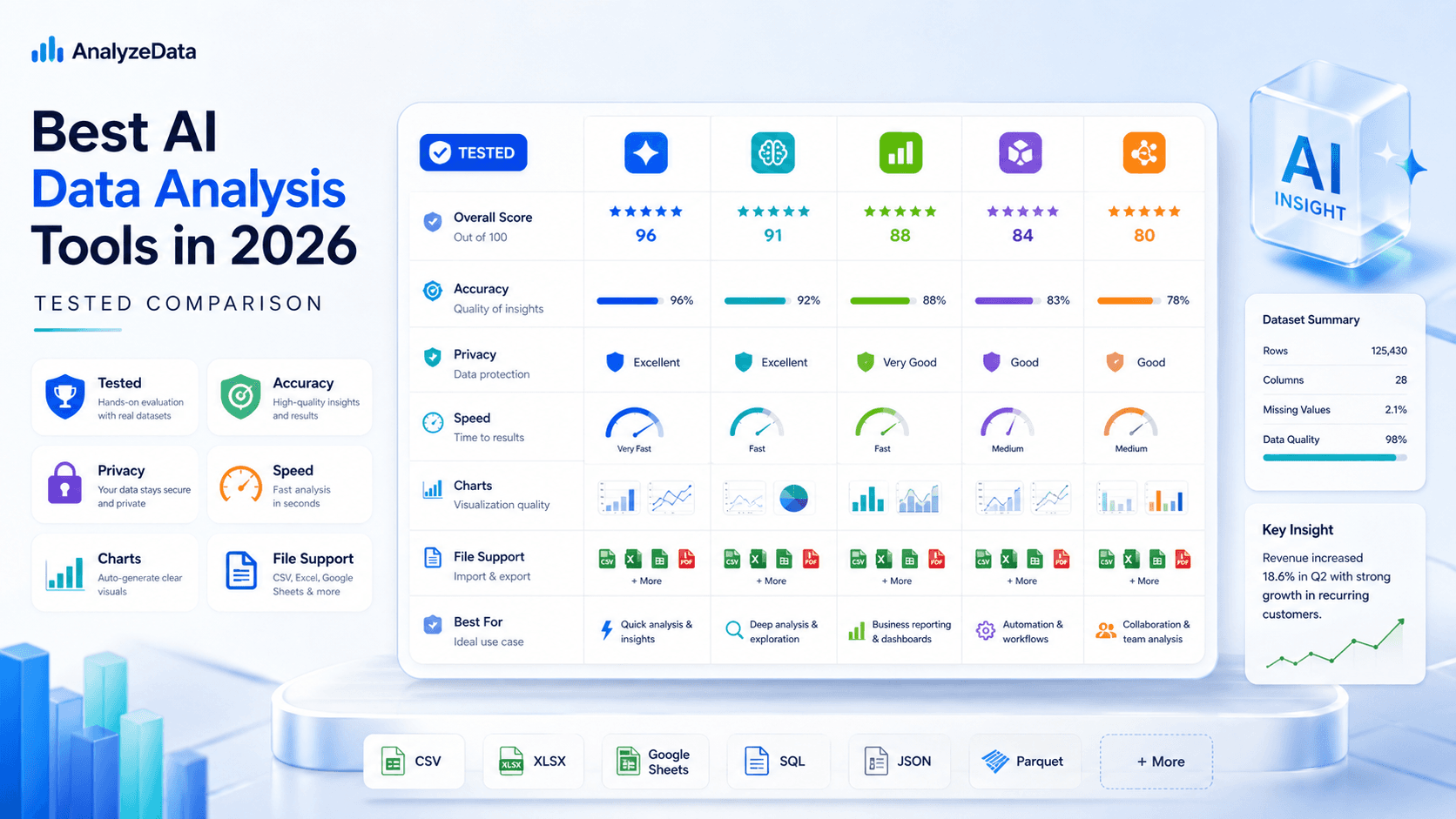
Best AI for Data Analysis (2026): Free Tools Compared
Which AI is best for data analysis? Compare 6 AI data analysis tools on accuracy, privacy, and price — including a free, no-signup analyzer for CSV and Excel.
ChatGPT Data Analysis: When It Works & a Free Alternative
Can ChatGPT analyze data? Yes. See how it handles CSV and Excel files, where verified charts and reports differ, and a free no-signup alternative.
How to Analyze CSV Data with AI (Free CSV Analyzer)
Analyze CSV data with AI free online — upload a CSV, ask in plain English, and get charts and statistics computed by real Python. No signup in open beta.